
Why your air conditioner is leaking water in the attic
The North Texas signature failure. Three causes, and what to do before the ceiling goes.
Written by the team at Panda Heating and Cooling · licensed TDLR TACLA128438C · published 5 September 2026
Turn it off first
If there is water coming through a ceiling, switch the system off at the thermostat before you do anything else. Set it to Off, not just up a few degrees.
The system is what is making the water. Every hour it runs is another few pints through your drywall, and drywall that has been wet for a day is a repair, while drywall that has been wet for three is a replacement. You are trading a warm afternoon against a ceiling.
Then put a bucket under it and call someone. This one does not wait until Monday.
Why an air conditioner makes water at all
It is not a fault. An air conditioner cools by passing warm indoor air over a very cold coil, and the moisture in that air condenses on the coil exactly like a glass of iced tea sweats on a July afternoon.
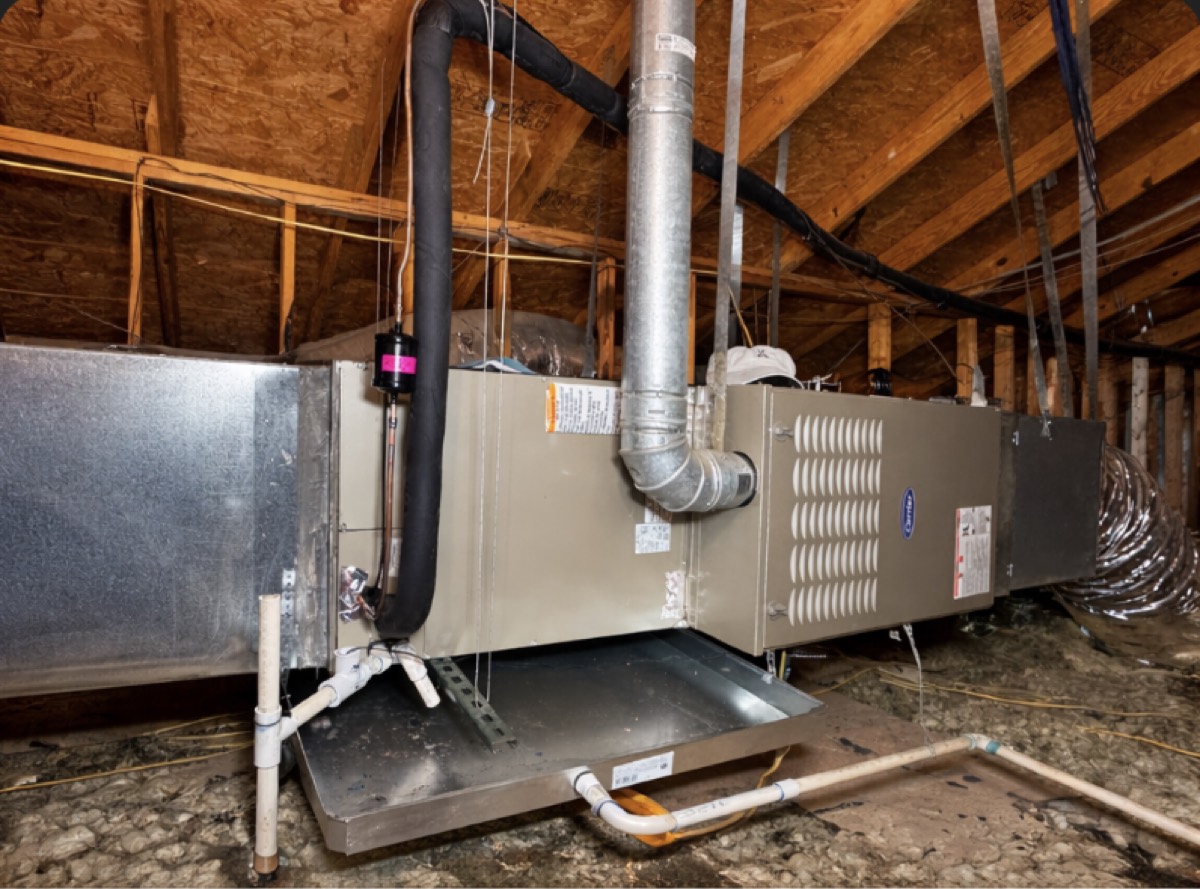
In a North Texas summer a working system pulls several gallons a day out of your house. That water drips into a pan under the coil, runs out through a drain line, and leaves. When any part of that path blocks, the water has to go somewhere else — and if your air handler is in the attic, somewhere else is your ceiling.
This is why attic installations leak and closet installations mostly do not. It is not that attic units are worse. It is that they are directly above your living room.
The three causes, in the order we actually find them
1. A float switch that failed — or was never there. This is the one we find first, and it is the one that turns a minor fault into a ceiling. There should be a safety switch that cuts the system off the moment the pan starts filling. When it works, a blocked drain is an inconvenience: the AC stops, you call, nothing gets wet. When the switch has failed, or the sensing wand is missing, or it was never wired in at install, the system happily keeps running and pumping water into your ceiling.
That is worth sitting with. The blocked drain is not usually what ruins the drywall — the missing safety is. We check it on every water call, because a house that flooded once without a working float switch will flood again.
2. A clogged condensate drain line. Algae and dust build into a plug in a three-quarter-inch PVC pipe, the pan backs up, and it overflows. Clearing it is routine, and on its own it is a small job.
3. A rusted-through secondary pan. Older systems have an emergency pan under the air handler to catch a primary failure. After fifteen years in a Texas attic they rust through, so the backup that should have saved the ceiling is itself a sieve.
There is a fourth, less common: a frozen evaporator coil that has thawed. If the leak followed a period of poor cooling, tell us — that is a different problem with a different fix, usually low refrigerant or airflow.
What you can check yourself
Not much, safely, and that is an honest answer rather than a sales one. Attics in September are 130°F and the walkway is joists.
What you can do from the ground: find the small white PVC pipe that exits your exterior wall, usually near the outdoor unit or under an eave. That is the secondary drain, and it is a warning light. If water is dripping from it, the primary drain is already blocked and the system is running on its backup. Nothing has come through the ceiling yet, but it is going to.
Call at that point and it is a straightforward job. Call after the ceiling stains and you are also calling a drywall contractor.
What it costs
The diagnostic is $75, waived if you go ahead with the repair. From there a water call runs from a simple drain clear up to about $1,000, and three things move it:
- Float switch — replace or fit? Replacing a failed one is quicker than fitting a switch to a system that never had one, which means running and wiring it.
- Does the drain itself need clearing? Often both jobs happen together, because the blockage is what exposed the missing safety.
- How many systems share the drain? Plenty of houses in Prosper and Celina run two or three systems tied into one line. That is more to clear, more to test, and more that can be the actual source.
We quote it before we start, and if we open it up and find a second problem we stop and show you rather than adding it to the invoice.
Preventing the next one
Condensate drains block again. That is the nature of a warm, damp, dark pipe. What changes the odds is catching it before it overflows — a float switch that actually works, and someone looking at the pan and the line before summer rather than during it.
That is what the Comfort Club is for — $150 a year for one system, which is less than two tune-ups bought separately and considerably less than a ceiling. If you would rather just book the tune-up, it is $99.
Still stuck?
We are in Celina and we cover Prosper, Frisco, McKinney and the towns between. Diagnostic is $75 and it is waived if you go ahead with the repair. The emergency line is answered 24/7.
Related questions
Can I pour bleach down the AC drain line myself?
You can, and plenty of people do, but be careful: bleach damages some drain pans and the metal around them over time. Distilled vinegar is gentler and works nearly as well. Neither will clear a drain that is already fully blocked — once it is plugged, the line needs to be cleared with vacuum or pressure, not dissolved.
How much does it cost to fix an AC leaking water?
The diagnostic visit is $75 and is waived if you go ahead with the repair. Beyond that it runs from a straightforward drain clear up to around $1,000 at the top end, and three things decide where you land: whether a float switch is being replaced or fitted for the first time, whether the drain itself has to be cleared, and how many systems share the same drain line — a two- or three-system house is more work than a one-system house. You get the number in writing before we start.
Is water leaking from my AC dangerous?
Not electrically, in most cases, but it does not stay a water problem. Wet drywall, wet insulation and a dark attic are how mould starts, and a saturated ceiling can come down without much warning. Treat it as urgent rather than annoying.
Why is my AC leaking water only at night?
Usually humidity. The system runs longer and produces more condensate in humid conditions, so a partially blocked drain that copes during the day gives up overnight. A partial blockage is still a blockage — it will become a full one.
