
Why your AC is running but not cooling
Six causes in the order a technician actually checks them — and two you can rule out yourself.
Written by the team at Panda Heating and Cooling · licensed TDLR TACLA128438C · published 5 September 2026
Rule out the two easy ones first
The filter. Hold it to a light. If light does not pass through it, you have found your problem. A blocked filter chokes airflow, the coil ices over, and an iced coil cannot cool anything. Replace it, then give the system a few hours — if the coil has already frozen it needs time to thaw before it will work.
The outdoor unit. Walk out and look at it. The fan on top should be spinning and the air coming off it should be hot. If the fan is not turning but you can hear a hum, that is usually a failed capacitor — a cheap, common part, and the single most frequent AC repair there is. If the whole unit is silent, check the breaker and the disconnect box on the wall beside it.
Also clear anything growing against it. Two feet of space all round. Grass clippings and cottonwood packed into the fins are a real cause of poor cooling in August.
If the outdoor fan runs and it still will not cool
Now it is one of four things, and all four need gauges. We see every one of them in a Celina summer — there is no single usual suspect here the way there is with furnaces, which is exactly why this is the call we will not price over the phone.
Low refrigerant. Refrigerant is not consumed — it is a sealed system, so if it is low there is a leak. Anyone who tops it up without finding the leak is selling you the same repair again next summer. On an R-22 system, which means roughly pre-2010, that conversation gets expensive fast because R-22 is no longer manufactured.
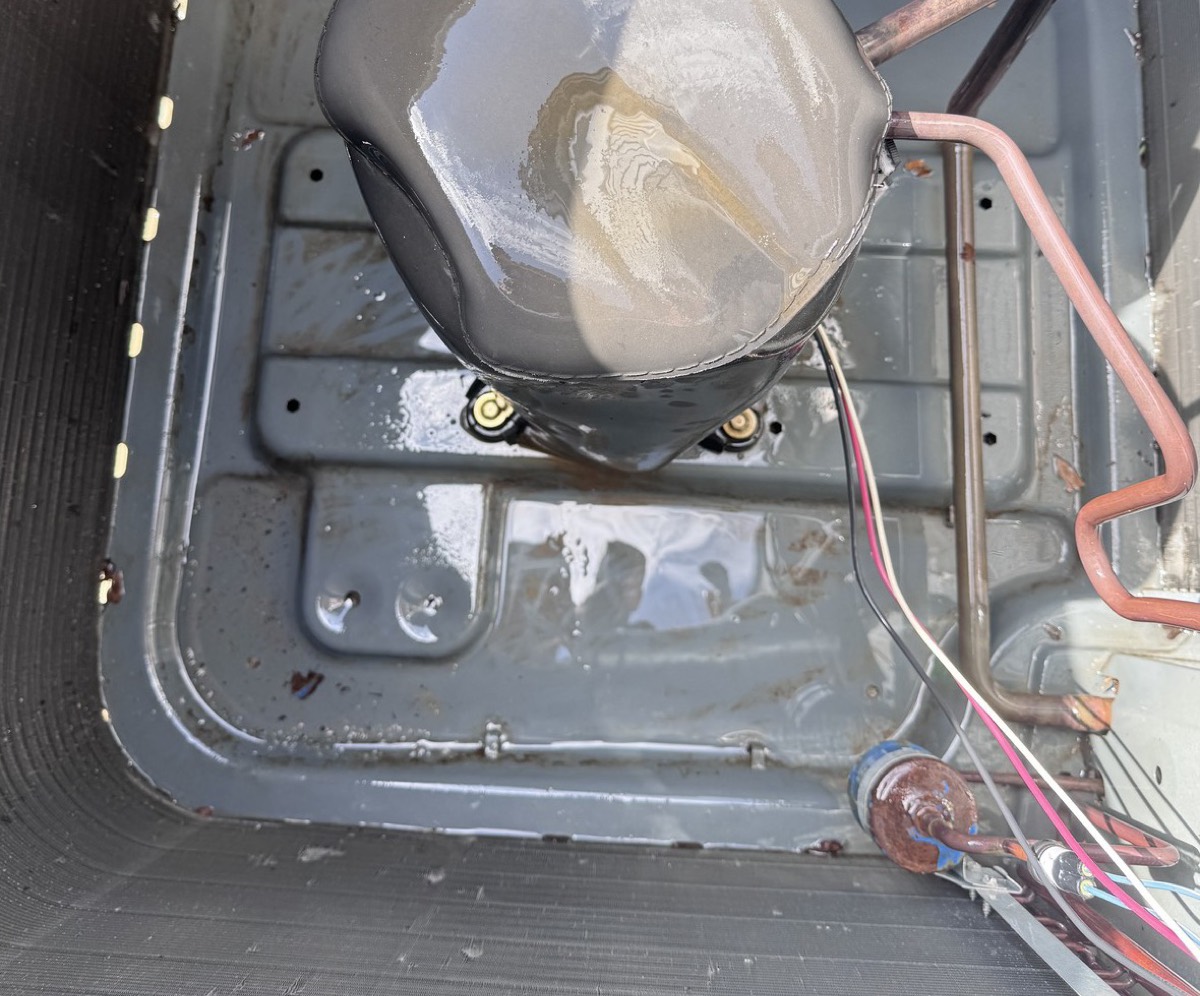
A failing compressor. The heart of the system. It runs, draws current, and does not compress properly any more. This is the expensive one, and it is usually the point at which repair-versus-replace becomes a real question.
A dirty condenser coil. The system cannot dump heat outside, so it cannot take heat from inside. Sometimes literally just dirt.
A stuck contactor or capacitor. Cheap electrical parts that stop the compressor engaging even though everything appears to run.
Why 20 degrees cooler is not always the goal
On a 105°F Celina afternoon, a correctly working air conditioner may not get a house to 72°F, and that is not necessarily a fault.
Most residential systems are sized to hold roughly 20 degrees below outdoor temperature. At 105°F outside that is 85°F inside at full tilt. If your house sat at 74°F all last summer and will not get below 82°F this year, something has changed and is worth looking at. If it has always struggled on the hottest ten days of the year, that is a sizing or ductwork conversation rather than a repair.
This is also why an oversized system is not better. It cools the air fast, shuts off before it has pulled any humidity out, and leaves you with a house that is cold and clammy. Sizing is done with a load calculation, not by matching the label on the old unit.
What a real diagnosis looks like
Every AC repair call starts with a full system check — static pressure, superheat and subcooling, amp draw on the compressor and the fan, capacitor microfarads, and a look at the ductwork and filter. You get the readings and the reason, in plain English, with photos.
The diagnostic is $75, waived if you go ahead with the repair. What we will not do is guess over the phone. Anyone who quotes you a repair price for a system nobody has looked at is either guessing or planning to change the number once they are in your attic.
Still stuck?
We are in Celina and we cover Prosper, Frisco, McKinney and the towns between. Diagnostic is $75 and it is waived if you go ahead with the repair. The emergency line is answered 24/7.
Related questions
Why is my AC blowing cold air but the house is not getting cooler?
Usually airflow or heat gain, not the equipment. Leaking or undersized ductwork loses cooled air into the attic before it reaches the rooms; poor insulation lets heat back in as fast as you remove it. If the air at the vent is genuinely cold and the house is not cooling, the problem is often between the unit and the room rather than inside the unit.
How long should my AC take to cool the house down?
Two to three degrees an hour is normal in a North Texas summer. If you come home to an 85-degree house and set 74, that is a four-hour job, not a fifteen-minute one. Setting it to 65 does not make it cool faster — the system has one speed.
Is it normal for the outdoor unit to run constantly on a hot day?
On the hottest afternoons, yes. A correctly sized system runs long cycles when it is 105 degrees outside, and long cycles are how humidity gets removed. Constant running on a mild day is different and worth a call.
Should I repair or replace an AC that is not cooling?
Under ten years old with a capacitor or contactor fault, repair, every time. Over fifteen with a compressor or a leaking evaporator coil, especially on R-22, the numbers usually favor replacement. We show you the math on both paths, including efficiency and financing, and let you decide.
